17th March 2026, paper
Semantic Canyons and Semiocapitalism
by Leon Magalhaes Schoyerer
themes: topology, semiological guerrilla
Cite as: Leon Magalhaes Schoyerer, “Semantic Canyons and Semiocapitalism”. Institute for Syntropic Research, 17 March 2026. https://syntropyinstitute.net/semantic-canyons-and-semiocapitalism/
Introduction
Starting from the concept of techno-linguistic automata sustaining the system of semiocapitalism (Berardi, 2017), this paper discusses potential alternative pathways of meaning-making through Deleuze and Guattari’s schizoanalysis. In analysing the phenomenology of schizophrenia, it discusses different topological models of semantic space and describes how the schizophrenic figure traverses these spaces in a subversive manner. By drawing its topological models from semiotic theory, such as Umberto Eco’s Encyclopedia and Jurij Lotman’s Semiosphere, this paper focuses on the “shallow cognitive map” hypothesis put forward by Musa et al. (2022); this theory interprets semantic space through the metaphor of “canyons”, carving out paths that channel information. This entrenchedness of semantic pathways is read in the context of the techno-linguistic automata inherent to semiocapitalism, which regulate the flows of thought, meaning-making, and subjectivity. A schizophrenic phenomenology, with its shallow associative landscape, represents a possible line of flight to the issue of semiocapitalism. Eco (1973) called for a semiological guerrilla that 1) acknowledges the cybernetic structure of global capitalism and 2) collectively targets strategic points within the system; this paper identifies the schizophrenic movement, collectivized in Guattari’s chaosmosis, as a phenomenon coherent with Eco’s proposal. Finally, by comparing linguistic systems to ecological systems, we identify the role of the schizophrenic figure in maintaining the openness and heterogeneity of system of language through the possibility of creating new paths.
1. Semiocapitalism and Semiological Guerrilla
Umberto Eco, in his 1973 Faith in Fakes, calls for the development of a semiological guerrilla. Eco’s proposal can be contextualized within both the rise of mass communication and its threat to human agency, and the broader political context of a global system of multinational companies. Eco argues that the “multinationals”, as he calls them, cannot be affected by terrorism, as he identifies terrorism as a calculated counterweight to global capitalism, a pressure valve to release the biological impulse for violence. Further, Eco criticizes the Red Brigades in their approach to resisting the global capitalist system through striking at the “heart of the empire”. He maintains that the militant group did not study cybernetics sufficiently, as the system of multinationals has no heart, and consists only of relations and veins that may regenerate after being damaged (Eco, 1973).
In his recent publication titled Futurability, Berardi (2017) elaborates on his concept of techno-linguistic automata that shape future behaviour. By this, he means automatic mechanisms in language that determine relations of power over individuals within capitalism. This leads to control being depersonalized, as no single individual can be held responsible. As an example, he mentions the automaton: “if you don’t pay your rent, you are automatically evicted”. Berardi argues that “these consequences are implicit in the technical machine, as if they were logico-mathematical necessities.” (Berardi, 2017, p.15). Although Berardi’s argument displays a degree of technopessimism, its relevance can be seen in the light of the increased automatization of language across different elements of society: be it in supermarkets, the workplace, or airports, human agents disappear alongside human accountability, and social behaviour is regulated through automated, technolinguistic codes. By this logic, “semiocapitalism”, in Berardi’s terminology, can function smoothly, without the need for ethical considerations.
The political problem of global capitalism, following Eco and Berardi, seems to be a semiotic problem, or at the minimum, a problem containing a semiotic dimension. Eco (1973) argues for a semiological guerrilla, and provides reflections on what techniques to apply. Drawing from network theory and cybernetics, he argues that an effective strategy would be to strategically target central nodes that uphold limbs of the system: “If there exists a completely automated factory, it will not be upset by the death of the owner but rather by erroneous bits of information inserted here and there, making work hard for the computers that run the place.” (Eco, 1973, p.115). Through semiological tactics, Eco aims to “restore to human beings a certain freedom in the face of the total phenomenon of communication”, through establishing within the communicative channels of semiocapitalism a subversive “critical dimension to passive reception” (Eco, 1973, p.144). In the following section, we consider the approach of Deleuze and Guattari to the problem of semiocapitalism; in their terminology, to its flows and codes.
2. Schizoanalysis as Semiological Guerrilla
For Deleuze and Guattari, the subversive potential against semiocapitalism is found in its deepest tendency, in its production of schizophrenic energy through de-territorialization (Woods, 2011). Similar to the Marxian dialectical analysis of capital, in which capital contains in its contradiction (labour) the seed for its eventual sublation, deterritorialization is described as both the drive and the limit of capitalism: in Anti-Oedipus, capitalism “continually seeks to avoid reaching its limit while simultaneously tending toward that limit.” (Deleuze & Guattari, 1972, p.34). Rather than drawing from the clinical condition of schizophrenia, Deleuze and Guattari construct a philosophical figure of the schizophrenic, which they call the “schizo”. They embark on the “first sustained close reading of schizophrenia” (Woods, 2011, p. 7), in order to describe the deterritorializing aspect of schizophrenic language that counters the territorializing dimension of capitalism.
The fundamental idea is that capitalism both deterritorializes language and territorializes it, whilst the “schizo” has the ability to disrupt the territorialization of flows, thereby posing a danger to semiocapitalism. According to Deleuze and Guattari, there are semiotic circles through which individuals may move, which are set up as center and periphery. In A Thousand Plateaus, Deleuze and Guattari describe how the movement through these semiotic circles is regulated by rules: “The jumps are not made at random, they are not without rules. Not only are they regulated, but some are prohibited: Do not overstep the outermost circle, do not approach the innermost circle..” (Deleuze & Guattari, 1980, p. 113). These rules correspond to Berardi’s concept of techno-linguistic automata. Lotman’s (1969) model of the Semiosphere presents a similar topology, in which the center of the semiosphere represents a dominant, unifying narrative, while movement through the semiosphere implies a semantic transformation. For Lotman, there is a strong need for spatialization of the subject through borders, leading him to conceive of topological language as a primary modelling system (Lorusso, 2015).
When the schizophrenic individual resists the rules regulating semantic space and moves too far from the center, he metaphorically “falls off” and becomes labeled as mad. The task of the schizoanalyst, then, is to remain close enough to the core not to fall off, but also far enough from the core to be able to practice resistance, to be subversive towards culture and language. Deleuze and Guattari’s (1972) topological analysis can be extended to Eco’s (1984) concept of the Encyclopedia, a reticular structure containing all possible paths of meaning-making. Lobaccaro has argued that the schizophrenic navigates the Encyclopedia differently (Lobaccaro, 2024), this could mean finding paths that escape linguistic automata.
Berardi (2017) argues that the transformation of the information landscape has led to an explosion of “semio-stimulations”, which have induced a form of collective schizophrenia: “A schizophrenic mode spreads across the social mind, but this distress is double edged: it is painfully chaotic, but can also be seen as the vibration that precedes the emergence of new cognitive rhythms.” (p. 25). Here, Berardi refers to Guattari, who saw the schizophrenic figure as the “bearer of paradigmatic change” through chaosmosis, the introduction of void (chaos) into order (cosmos). As Anti-Oedipus argues, it is not possible to separate a form of collective chaosmosis from global systems of technological capitalism. Yet, this movement may represent collective points of resistance targeted at strategic nodes, representing precisely what Eco saw as an effective strategy against cybernetic systems.
Here, it is important to be careful not to glorify schizophrenia. Deleuze and Guattari extract semiological patterns for their philosophical purpose, but in the clinical sense, schizophrenia remains a harmful disease. In fact, schizophrenia can be seen in the backdrop of cybernetic capitalist regimes: “The power play of cybernetic power is to give everyone the impression that they have access to the whole world when they are actually more and more separated” (Invisible Committee, 2017). In fact, schizophrenia is a disease that may be characterized by isolation. As Lobaccaro writes: “The schizophrenic subject is alone in the face of infinite encyclopedic planes; community does not pulsate in his language. We can all learn a lesson from this: alone, we are destined to lose ourselves in encyclopedic labyrinths.” (Lobaccaro, 2024, my translation).
Hence, there are two possible lines: in one, the cybernetic regime, through its deterritorializing flows, leads to isolation and collective schizophrenia. In the other, the cybernetic regime is successfully overcome through a chaosmotic movement towards collectivity, where the echo-chambers emergent in mass communication are overcome. As Mark Seem puts it in the introduction to Anti-Oedipus: “Madness is a radical break from power in the form of a disconnection. Militancy, in Deleuze and Guattari’s framework, would learn from madness but then move beyond it, beyond disconnections and deterritorializations, to ever new connections. A politics of desire would see loneliness and depression as the first things to go.” (Deleuze & Guattari, 1972, p. 23).
A critical lesson that Deleuze and Guattari take from madness is precisely a cybernetic one. In A Thousand Plateaus, a continuation of Anti-Oedipus representing a positive exercise in rhizomatic writing, they argue: “When one writes, the only question is which other machine the literary machine can be plugged into, must be plugged into in order to work.” (Deleuze & Guattari, 1980, p. 4). In analysing semiocapitalism, we may identify and unplug fascist machines and isolating machines. In the follwing, we look at conceptualizations of the neural structures present in schizophrenia through the model of cognitive maps, in order to further our topological analysis of dissident semantic space.
3. Semantic Canyons and Shallow Cognitive Maps
In this section, we look at conceptualizations of the neural makeup of the schizophrenic mind. This approach can be read through the field of cognitive semiotics: we draw from both theories of signs (semiotics) and theories of mind (cognitive sciences) to arrive at a clearer image of schizophrenic phenomenology. Our starting point is a recent study by Musa et al. (2022), which puts forward the hypothesis that schizophrenia is characterized by a shallow cognitive map – an internal mental representation of one’s environment. The authors suspect a deviant shallow associative landscape as opposed to a relatively stable landscape of hills and valleys, representing the semio-linguistic rules and automata discussed in the previous section. Since the semantic canyons of people with schizophrenia are more shallow, their trains of thought may traverse different contexts, straying from conventional associations. In the terminology of Deleuze and Guattari (1980), this represents “smooth space” as opposed to “striated space”.
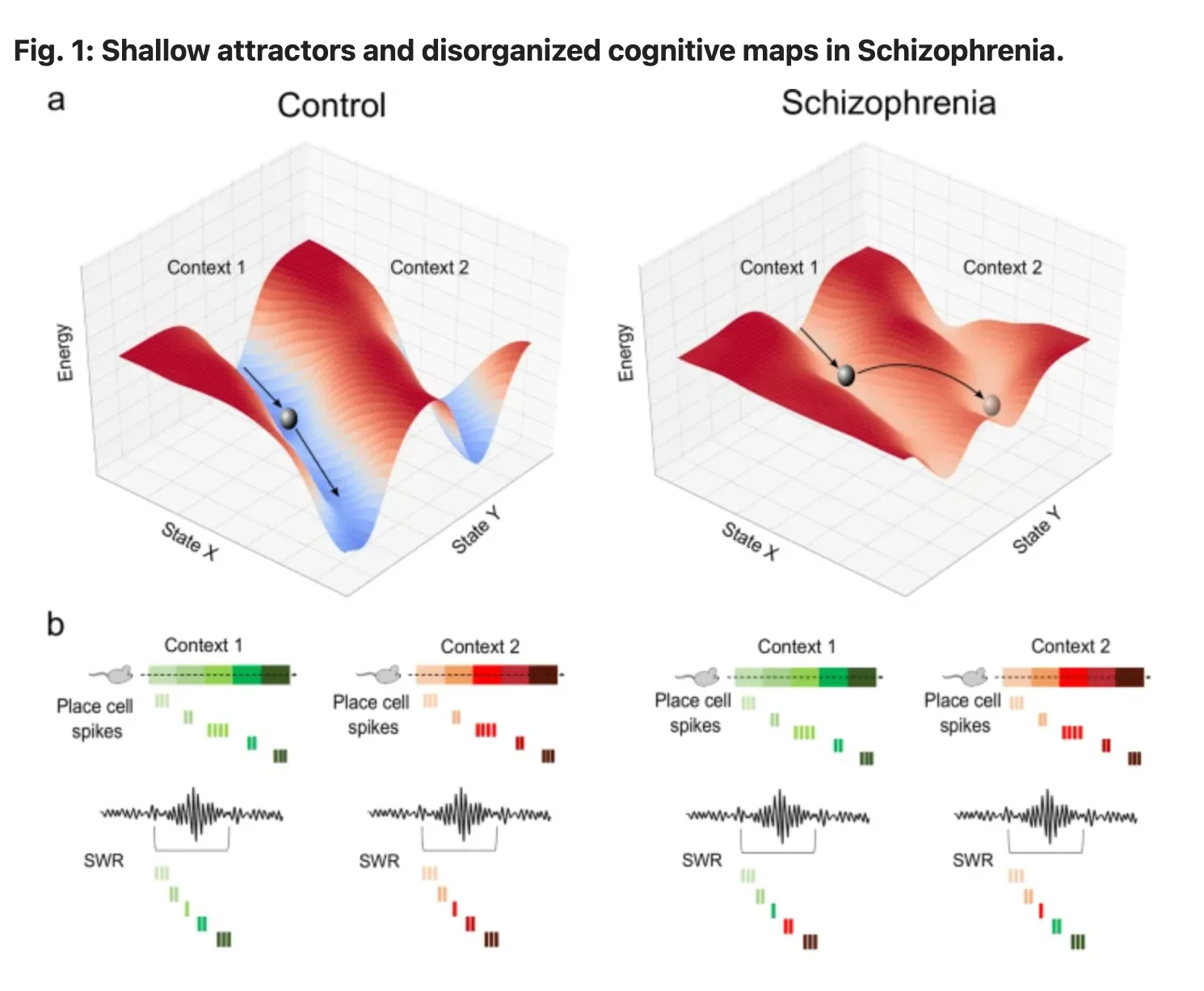
By this mechanism, what is conventionally accepted as a valid proposition, like “I am myself”, is replaced with chains of unusual associations, leading to propositions like “I am the pope”. An example for such discursive derailment is found in one of Bleuler’s (1911) patients:
“I am writing on paper. The pen which I am using is from a factory called “Perry and Co.” The factory is in England. I assume this. Behind the name of Perry and Co. the city of London is inscribed; but not the city. The city of London is in England. I know this from my school days. Then, I always liked geography.” (Bleuler, 1911, p. 50)
Deleuze and Guattari (1980) call this de-territorialization, which holds subversive potential precisely because semiocapitalism requires stable linguistic identity (labour) to function properly. When a stable identity becomes unstable, a further automaton activates, excluding that person from the social sphere and the semiosphere alike.
The study by Musa et al. (2022) is compatible with Eco’s concept of the Encyclopedia, since thought is represented as semantic space. The shallow cognitive map hypothesis corresponds to the movement of the schizophrenic individual in the encyclopedia. As opposed to the Encyclopedia, Lotman’s (1984) and Deleuze and Guattari’s (1972) topological models of semantic space contain a relatively stable core and periphery. Here, the shallow cognitive map hypothesis would describe the schizophrenic move from core towards periphery. The hypothesis proposed by Musa et al. (2022) can be understood as a representation of semantic space through the metaphor of canyons. Canyons can be defined as deep valleys with steep sides through which a stream of water flows. Water takes on the role of representing thought: as the water flows repeatedly, it carves out a path that channels further thought, creating over time a relatively rigid system of flows. It is often the case that new theories are intended to break these entrenched paths. By making new arguments, by finding new framings for political debates or for medical diseases, theoreticians try to find alternative routes to modify the status quo. In the same way, the analyst undertakes a temporary disruption in his subjectivity in order to study the irregular language patterns present in schizophrenia.
A notable parallel to the schizophrenic phenomenology plays out in the phenomenology of psychedelic use. Psychoactive substances create a temporary disruption of consciousness and ontology, which can range from milder forms of consciousness-transformation up to complete ego dissolution. Clinical research shows that under the influence of psychedelic substances, brain entropy momentarily increases (Herzog et al., 2023). This can have therapeutic effects even in complex cases such as treatment-resistant depression: deeply ingrained ways of thinking, or “canyons”, are broken down, allowing for the formation of new, more adaptive cognitive pathways. We cannot draw direct parallels to schizophrenic language, but the phenomenology presents similar structures occurring at the level of subjectivity. A study published by Petri et al. (2014) shows increased integration between cortical regions in the psilocybin state, which can be seen in Figure 2 below:
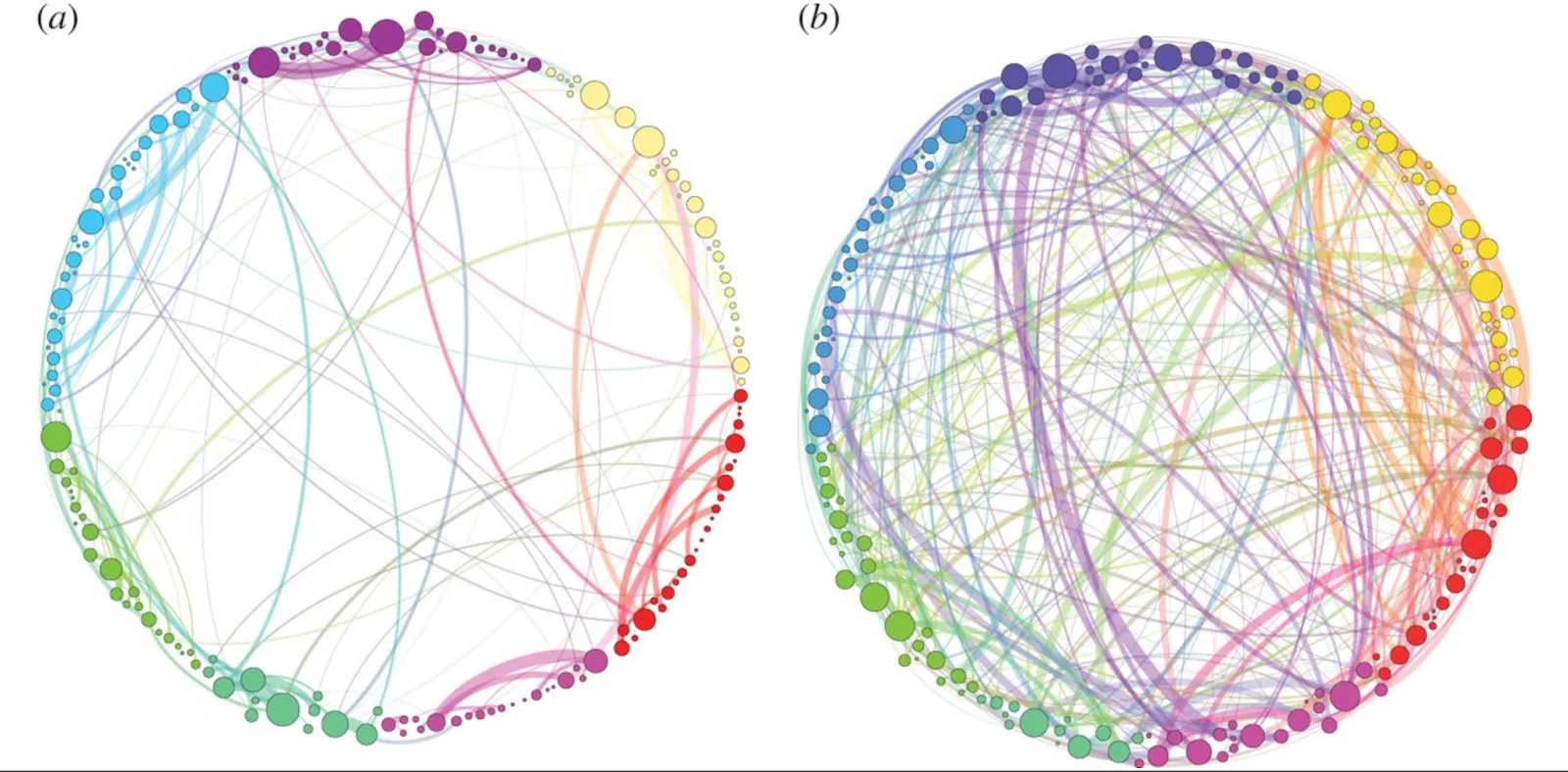
While connectivity between certain cortical regions increases after the administration of psilocybin, there is a decrease in connectivity and blood flow in the default mode network (DMN) (Gattuso et al., 2023). The DMN is a mechanism responsible for self-consciousness and self-representation and is more strongly activated in schizophrenia (Kim et al., 2014). Indeed, several researchers hypothesize that schizophrenia fundamentally represents an issue with self-consciousness: Frith (1992), for instance, argues that the issue resides in an impairment of the prefrontal cortex, which is responsible for metarepresentative function. For Frith, schizophrenia represents a disorder of higher-level cortical capacities underpinning self-consciousness and subjectivity.
The study of semiotics, particularly that of cognitive semiotics, has been concerned precisely with the issue of subjectivity in relation to semio-linguistic structures, making it particularly equipped to take on the question of impaired modes of subjectivity present in schizophrenia (Lobaccaro, 2022). Starting from C. S. Peirce, the founding father of interpretative semiotics, subjectivity is understood in terms of signs. He writes that “we have no power of thinking without signs” (Peirce, 1868) and concludes that “man is a sign”; cognitive identity is defined through our signs and our interpretations thereof. Further, for Greimas, subjectivity derives from the linguistic “I”: this idea is compatible with contemporary cognitive semiotics (Paolucci, 2021). As Paolucci (2021) posits, “semio-linguistic structures build an indispensable scaffolding which brings cognitive structures forth.” (p. 29).
In Deleuze and Guattari (1972), schizophrenic subjectivity is defined through the “Body without Organs”. Briefly put, the phenomenology of the schizophrenic individual interprets everything, even his own organs, as a machine: “Celestial machines, the stars or rainbows in the sky, alpine machines— all of them connected to those of his body.” (p.9). As schizophrenia seems to be deeply tied to the question of subjectivity, and as subjectivity is built through semiotic scaffolding, the phenomenon of schizophrenia seems deeply tied to semiotic structures. Indeed, Musa et al. (2022) further hypothesize how the mental disorder comes about, and their schematization involves genetic and environmental factors, which, as we will see in the following, are semiotically mediated.
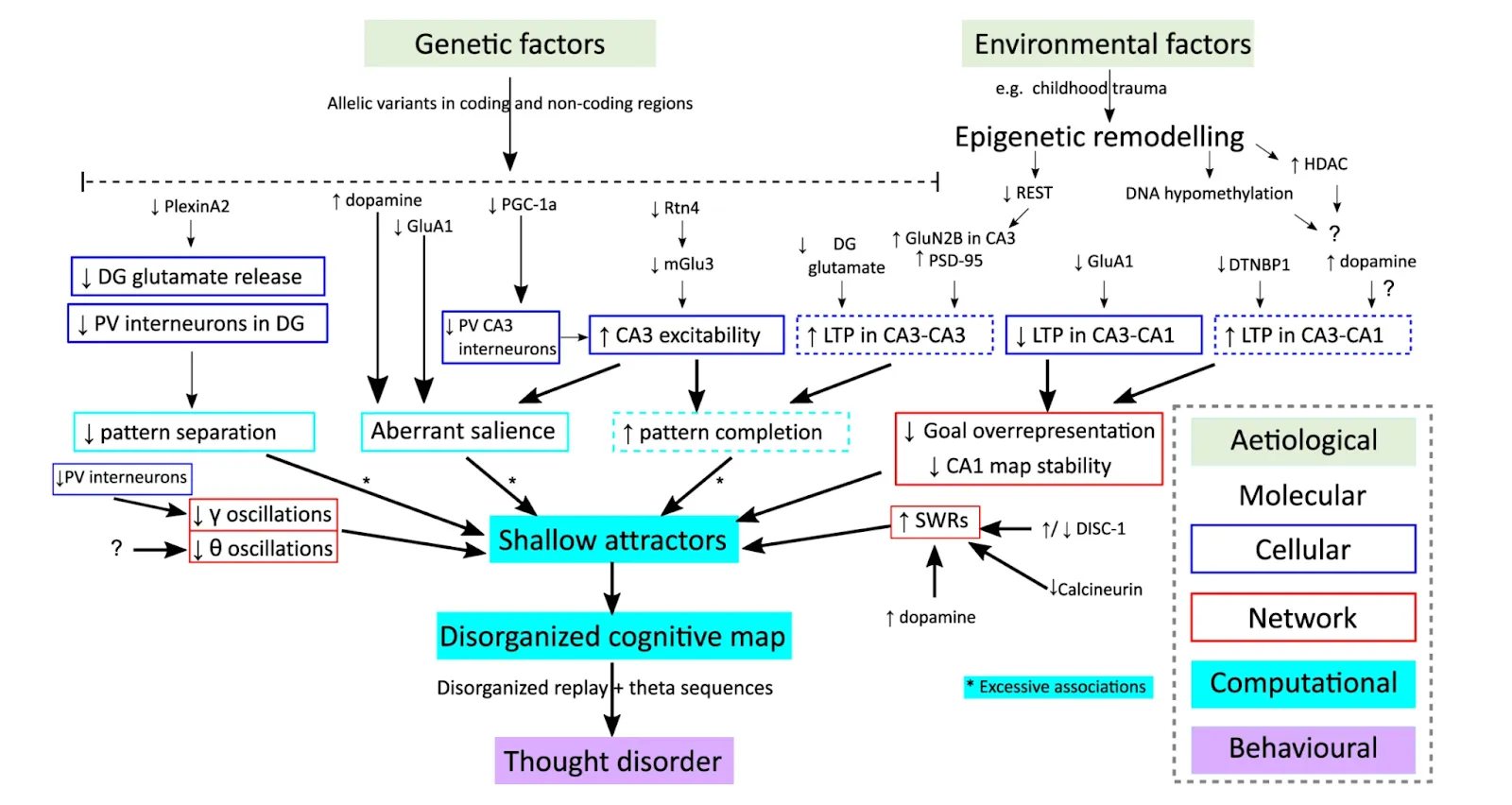
Figure 3 shows a schematized bottom-up construction of schizophrenia: from molecular, cellular, and network levels, to computational and behavioural levels. This approach takes genetic and environmental factors as the main inducers of schizophrenia. Environmental or “cultural” factors, which lead to epigenetic remodelling, have a semiotic dimension because, as Brinkmann (2014) puts forward, “the entire range of material and semiotic mediators – organized in different social practices – can be referred to with the term culture.” (Brinkmann, 2014, p.123). Further, it can be said that the genetic factors themselves represent a form of semiotic language. As Jakobson (1973) has argued, genetic and verbal systems of information have similar properties, since the DNA represents “a language as old as life itself” (p.49), and acts as the “keystone” of evolution.
Further, if we accept the premise that there is a physiological cause for schizophrenia, it becomes possible to imagine a cure. An article by Drew (2019) titled Agency and the algorithm shows how brain-computer interfaces (BCIs) are used to treat depression through electrical stimulation; importantly, this treatment can be applied to other diseases. It functions through electrodes which are permanently inserted in the brain and function as electrical control loops. Given the complexity of the regulation processes, these loops are steered by artificial intelligence, which raises fundamental questions about agency. If we hypothesize an automated cybernetic regulation process for diverging forms of subjectivity, as is the case in schizophrenia, this means a further triumph of semiocapitalism and the cybernetic regime. Through a sensory and cognitive regulator, a person with a mental disorder can automatically be restored to normalcy. What is left is the eerie feeling so brilliantly evoked by the “mood-regulator” in Phillip K. Dick’s Do Androids Dream of Electric Sheep?: we no longer know whether we are happy naturally or artificially. This possible future signifies the completion of an ars oblivionalis, an art of active forgetting that Eco believed to be impossible.
4. Language Systems as Ecological Systems
In this final section, we argue briefly for a structural similarity between linguistic and ecological systems, in order to draw lessons from ecology towards systems of language. In the same way that there are thermodynamic limits within ecological systems, as for instance described by Kleiber’s law, we may argue that there are thermodynamic limits within systems of language. The acceleration of language production through the continuous generation of content by LLMs, running laps through the Encyclopedia, is a further symptom of thermodynamic limits. The exploration of uncharted realms has reached a point where few things seem exciting, and a lack of novelty is experienced. Without new input, a thermodynamic system goes from being an open system to being a closed system; in this case, collapse is bound to happen. What has been discussed in the previous sections about the movement of the schizophrenic individual through the Encyclopedia represents an antidote to this, as new connections are introduced and the system is kept open.
There are further similarities between systems of language and ecological systems: there exist invasive behaviours, delicate balances, tipping points, and most of all, concrescence in the sense of Whitehead. Languages have “structural regularities, dynamic equilibrium, and cohesive power” (Jacobson, 1973, p.53), which are necessary for verbal structuration. Further, Jacobson argues a crucial point: “If, furthermore, biologists realize that the indispensable diversity of all individual organisms, far from being incidental, presents ‘a universal and necessary phenomenon of living things’, linguists, in turn, recognize the creativeness of language in the unlimited variability of personal speech and in the infinite diversification of verbal messages. Linguistics shares with biology the view that ‘stability and variability reside in the same structure’ and imply each other.” (p.53).
If stability and variability are linked, this emphasizes the need to maintain openness in a system of language, to find alternative paths in order to ensure that language remains an “open system”. A negative example of this is observed in model collapse of LLMs, where inputs and outputs lack “rare events” and become overly homogenous, leading to system collapse (Shumailov, 2023). We may not find new paths through venturing into new territory, but through the reduction of established connections for the purpose of freeing up computational space in the semiosphere. As the material conditions change, concepts need to remain flexible, and flexibility requires a degree of disintegration. A highly integrated system may work well for a momentary state, but fails in structurally fluctuating environments. This highlights the need to return systems of language to a grass-roots level. As we have tried to demonstrate, the derailment practiced by the “schizo” presents a line of flight to keep the system of language open.
Conclusion
In looking at different topological models for representing semantic space, we have outlined how semio-linguistic control mechanisms inherent to semiocapitalism carve out paths that define further meaning-making. Through the shallow cognitive map hypothesis, we have described the movement of the schizophrenic individual as it ventures through these canyons differently. The argument runs parallel to Lobaccaro’s (2024) conception of how the schizophrenic individual navigates Eco’s Encyclopedia without the steering mechanisms provided by “common sense” (Lobaccaro, 2024). From cognitive semiotics, we draw that subjectivity is inherently semiotic; as a consequence, subjectivity may be deeply capitalist, but may also be freed from territorialized flows. Eco’s semiotic guerrilla entails the system-wide insertion of “erroneous bits of information”; in our context, this type of information could be inserted precisely by the “schizo”, which in Anti-Oedipus “scrambles all the codes” (Deleuze & Guattari, 1972, p.15), leading to a collective chaosmosis. In this process, the openness of our language systems is maintained. The semiotic code of schizophrenia thus presents us with a possible solution for the transformation of the semiosphere, reshaping it into a shallower and less hierarchical space of subjectivity.
References
Berardi, F. (2017). Futurability: The age of impotence and the horizon of possibility. Verso Books.
Bleuler, E. (1911). Dementia praecox or the group of schizophrenias. International Universities Press.
Brinkmann, S. (2014). Psychiatric diagnoses as semiotic mediators: The case of ADHD. Nordic Psychology, 66(2), 121-134.
Deleuze, G., & Guattari, F. (1972). Anti-Oedipus: Capitalism and Schizophrenia. New York, London: Penguin Classics.
Deleuze, G., & Guattari, F. L. (1987) [1980]. A Thousand Plateaus: Capitalism and Schizophrenia (B. Massumi, Trans.). Minneapolis, MN: University of Minnesota Press.
Drew, L. (2019). Agency and the algorithm. Nature, 571, 19-21.
Eco, U. (1984). Metaphor, dictionary, and encyclopedia. New Literary History, 15(2), 255-271.
Eco, U. (1995) [1973]. Faith in fakes: Travels in hyperreality. Random House.
Frith, C. D. (1992). The cognitive neuropsychology of schizophrenia. Lawrence Erlbaum Associates, Inc.
Gattuso, J. J., Perkins, D., Ruffell, S., Lawrence, A. J., Hoyer, D., Jacobson, L. H., … & Sarris, J. (2023). Default mode network modulation by psychedelics: a systematic review. International Journal of Neuropsychopharmacology, 26(3), 155-188.
Herzog, R., Mediano, P. A., Rosas, F. E., Lodder, P., Carhart-Harris, R., Perl, Y. S., … & Cofre, R. (2023). A whole-brain model of the neural entropy increase elicited by psychedelic drugs. Scientific reports, 13(1), 6244.
Jakobson, R. (2014). [1973]. Main Trends in the Science of Language (Routledge Revivals). Routledge.
Kim, J. S., Shin, K. S., Jung, W. H., Kim, S. N., Kwon, J. S., & Chung, C. K. (2014). Power spectral aspects of the default mode network in schizophrenia: an MEG study. BMC neuroscience, 15(1), 104.
Lotman, Y. M. (1989). The semiosphere. Soviet Psychology, 27(1), 40-61.
Lobaccaro, L. (2022). Default Mode Network, Schizophrenia, and Narrativity. Comments on Psychopathology of Language. RETI SAPERI LINGUAGGI, 9(2), 285-314.
Lobaccaro, L. (2024). Persi nell’Enciclopedia: una prospettiva semiotica su schizofasia e senso comune. Versus, 53(1), 149-170.
Lorusso, A. M. (2015). Cultural semiotics. Basingstoke: Palgrave Macmillan.
Musa, A., Khan, S., Mujahid, M. et al. The shallow cognitive map hypothesis: A hippocampal framework for thought disorder in schizophrenia. Schizophr 8, 34 (2022). https://doi.org/10.1038/s41537-022-00247-7
Paolucci, C. (2021). Cognitive Semiotics. Radical Enactivism, Pragmatism and Material Engagement. In Cognitive semiotics: Integrating signs, minds, meaning and cognition (pp. 1-25). Cham: Springer International Publishing.
Peirce, C. S. (1868). Some consequences of four incapacities. The Journal of Speculative Philosophy, 2(3), 140-157.
Petri, G., Expert, P., Turkheimer, F., Carhart-Harris, R., Nutt, D., Hellyer, P. J., & Vaccarino, F. (2014). Homological scaffolds of brain functional networks. Journal of The Royal Society Interface, 11(101).
Shumailov, I., Shumaylov, Z., Zhao, Y., Gal, Y., Papernot, N., & Anderson, R. (2023). The curse of recursion: Training on generated data makes models forget. arXiv preprint arXiv:2305.17493.
The Invisible Committee (2017). Now. Semiotext(e), Intervention series 23.
Woods, A. (2011). The sublime object of psychiatry: Schizophrenia in clinical and cultural theory. International Perspectives.
Leon Magalhaes Schoyerer is the Founder and Editor of the Institute for Syntropic Research (ISR). He studied Philosophy at Humboldt University and Social Sciences at Amsterdam University College. He is currently pursuing a Masters degree in Semiotics at the University of Bologna. His research traces links between philosophy and systems theory.